Thursday, 3 March 2011


Election Watch Part VII - Chilli Crab Recipe Tailored For Cooking Productivity
In my posting on Feb 24 on the Election Budget 2011, I expressed my reservation how the Govt. can increase personal income by 30% over the next 10 years, even in my capacity as a working PMET. I am not seeing income being increased to cover inflationary figures for the last few years, not to say cover further increase due to productivity.
My reservation is mooted by my own experience in the construction industry, having worked as a professional quantity surveyor for more than 23 years and gone through multi-miilion mega-sized private and public projects. Over all these years, I have seen how my own profession has "evolved", if not "eroded"; with the bringing of "foreign talents" while pay was marginalised. It is also the sector which is still most reliant on foreign labour. But most of all it is because "productivity" is an abstract word, people often look at its costs of implementation first, before looking at its fruits, and calling it off.
My reservation is mooted by my own experience in the construction industry, having worked as a professional quantity surveyor for more than 23 years and gone through multi-miilion mega-sized private and public projects. Over all these years, I have seen how my own profession has "evolved", if not "eroded"; with the bringing of "foreign talents" while pay was marginalised. It is also the sector which is still most reliant on foreign labour. But most of all it is because "productivity" is an abstract word, people often look at its costs of implementation first, before looking at its fruits, and calling it off.
The Govt announced in Parliament that nearly half of the $1 billion in productivity fund had been disbursed, a year since a raft of measures were taken to cure the economy's Achilles Heel. The construction indutsry is one of the 12 sectors chosen to benefit from the National Productivity Fund. Together with the Retail, Electronics and F and B sectors, the Govt had given its nod for these 4 sectors which account for a quarter of our total GDP and one third of our country's workforce.
DPM Teo Chee Hian reported in Parliament that productivity rose by 10.7% last year on the back of our stellar economic recovery. WOW so "impressive, spectacular and easy" that it makes the 2%~3% annual productivity target Singapore is driving look ridiculously low, silly but easy to achieve. But honestly from my own heart, not a drip from this normous fund has touched my heart to see anything optimistic to link it for a pay increase.
Yardstick #1
Half of S$ one billion has been disbursed and if the construction industry has taken a quarter of that, I have not yet seen where it is buttered to make this industry look more productive. Personally, I do not see my job as a PMET in this industry as honourable a job to ever dream to command the same pay as the profession in the highly profiled case of Dr Susan Lim, less to say of our world-class politicians.
 |
What measures have visibly been taken with half of the National Productivity Fund already disbursed? |
Yardstick #2
Next, is my personal yardstick for assessing productivity on our public service. Several months back, I had written this letter of complaint to one of our highest public office about the lack of responsibility and poor service provided by one of the lower governmental body. Months passed but it is still not given a deserving coherent reply, although the responsible party had written to push away his responsibility. I believe it must have ended up as a successful "covering-up" attempt, well known since my own NS days.
Just by using these 2 yardsticks, I am already confused how productivity could have risen 10.7% as cited in Parliament and would continue to rise further, with half a dosage of the National Productivity Fund as initial medicine for our "low" productivity when most are already working the longest working hours in the world. Are you frustrated now to hear DPM Teo again asking for a pay increase for the public sector, after this year's budget had allowed a 30% increase in the estimated salary for political appointments, because this is a result of GDP linked bonus payments which include Ministers and was due to last year's "exceptionally high" GDP growth?
Next in last year's Budget, S$4 billion was borrowed from our RESERVES to save jobs and keep us STAY EMPLOYED. Plus half of S$ 1 billion to bring us 10.7% productivity. So why does the Govt not just lend and rolled out the same $4 billion from the reserves for another year and then release the the balance of $1 billion National Productivity Fund for another year to realise another year of 10.7% productivity growth and the same low unemployment?
By now many must have read or heard about SM Goh's "Chilli Crab" recipe for giving Singaporeans a chance to vote for a "good candidate" from a "good party" because "it is the quality of candidates and the reputation of the political party that counts in an Election". While we may contend whether to vote for "No Sign Board" or "Big Sign Board" chilli crabs, his "recipe" still does not ensure that good policies would be crafted and implemented by our expensive political and civil service machinery.
As the PAP and Opposition members “crossed swords” on TV, the Reform Party Chief had claimed that "the Govt had plagiarised its stance on productivity”.
PAP MP Indranee Rajah rebutted by saying “I thought that back in the ‘70s, we had launched the productivity movement; we had the productivity and standards board. That was something like a good 30 years or more ago … before the RP came up with its recent statement.” Well said, but why had that productivity movement been stopped, and if not; why has it failed to deliver in the hands of the PAP Govt? That we now have to catch up annual productivity by 2~3% in order to increase real income by 30% over the next 10 years, what had our Govt been doing?
With nearly half the National Productivity Fund disbursed, are we still "muddling through" what "productivity" really is? Will increasing annual productivity by 2~3% really help to increase our pay by 30% in ten years? Certainly not optimistic as I see it. But we have just heard that the civil service will get 30% more bonus for last year's spectacular economic performance. If the construction indutsry has contributed towards that, I am not even seeing a direct link to a jump in my own salary. Perhaps, what we really need to know and do is to "re-engineer" our own "profession" like turning the medical profession into a subcontracting business in the construction industry to claim the highest fees in the world as in the "SMC vs Dr Susan Lim" case, and in this; we certainly would need a "Chilli Crab Recipe Tailored For Cooking Productivity". And this is sad as for a country or even just a city.
Meanwhile, would you like to "join me" to appreciate this simple home-cooked HAIRY CRAB meal which costed me RMB 25 or S$5.00 for this portion?
Reference # 01 |
| Home Cooked Hairy Crab Meal ! |
TODAY 28 Feb 2011
PAP, Opposition members cross swords on TV
Reference # 02
TODAY 28 Feb 2011
Quality of candidates is what matters: SM Goh
Reference # 03
TODAY 3 Mar 2011
DPM Teo on salary issue
Monday, 28 February 2011
Thursday, 24 February 2011
Election Budget 2011, The Middle Class Income Stagnation & "Lost" in Retirement Fund
The current hottest topic in town and the Blogosphere must be ELECTION BUDGET 2011. The Budget always has its greatest bearing on the Middle Class. This class forms a substantially big tax base while their income earnings are often constrained by various factors. Every "squeeze" on the Budget by the Govt. will certainly impinge on this sandwiched class like a nasty "pinch" to the extent that many now feels that the highly acclaimed "tripartite relationship" between Govt. / Employers / NTUC is more of a nuisance, especially with so many non-unionised firms.
The lowest "underclass"/"working poor"/"lower class" or "the poor" will always be taken care of and given the most "goodies", especially in an Election year. The "Capitalist" /"Upper Class"/ "Super-Rich" and "Rich" Class simply will not be bothered by the Budget due to the enormous wealth and personal assets under their control.
If you are not sure how the class grouping is done, you may refer to this article in the Wikipedia. The "Academic Class Models" are categorized uniquely by researchers in the US :-
(a) Dennis Gilbert (2002)
(b) Leonard Beeghlev (2004)
(b) William Thompson and Joseph Hickey (2005)
In Singapore, there is a new group of "will not be bothered", not because they are super-rich; but because they belong to the "Upper Middle Class" and it seems like the Govt.'s complex tax and welfare policies will diligently seek to deprive them of many priviledges in order to "squeeze" and create some savings for the Budget.
In Singapore, the classification seems to follow pretty closely to the William Thompson and Joseph Hickey Model in the US.
(1) For Growth Dividends
The headlines screamed "All adult Singaporeans will get $100 to $800 to be paid in May. These Growth Dividends will cost the Govt $1.55 billion." If you check the details, you will find that if your income is above $100K you will get $100 goodies. If you earn between $30K ~$100K, you get between $300 to $800 depending on the annual value (AV) of your property.
Making a comparison to the William Thompson and Joseph Hickey Model in the US, if you earned the high 5-figure range above $75K to above $100K, you belong to the "Upper Middle Class". For earning between $30K ~ 75K, you belong to the Lower Middle Class and so on.
[Note : Making comparison on currency parity without adjusting for exchange rate]
[Note : Making comparison on currency parity without adjusting for exchange rate]
(2) For Medisave Top Ups
If you check the details, you will see that if your income is above $100K; you will not be entitled to Medisave Top Ups.
If your income is $30K or less and AV of your residence is $7000 or less, you get between $300~$700 in top-up depending on age.
If your income is $30K or less and AV of your residence is more than $7000 or if you earn between $30,001 ~ $100K, you get between $200 to $600 depending on age.
Making a comparison to the William Thompson and Joseph Hickey Model in the US, if you earned less than $30K, you belong to the "Working Class" or "Lower Class".
And in Singapore, it is probably the "Lower Class" who are entitled to the "hotly-debated-in-Parliament" S$200 plus odd social welfare grant from the Govt.
Making a comparison to the William Thompson and Joseph Hickey Model in the US, if you earned less than $30K, you belong to the "Working Class" or "Lower Class".
And in Singapore, it is probably the "Lower Class" who are entitled to the "hotly-debated-in-Parliament" S$200 plus odd social welfare grant from the Govt.
(3) Utilities and Conservancy Rebates
For 1 and 2 Room HDB Flat : U-save rebate of $360 and 3 months S and CC rebates.
For 3 and 4 Room HDB Flat : U-save rebate of $340 and #320 respectively and 2 months S and CC rebates.
For 5 Room HDB Flat : U-save rebate of $270 and 1.5 months S and CC rebates.
For Executive HDB Flat : U-save rebate of $235 and 1 month S and CC rebates.
If you stay in private property, you don't enjoy rebates; although you pay taxes generally, not to mention higher property taxes.
(4) Healthcare and Means-Testing
I recall I wrote to My Paper in Mar 2008 regarding MOH's criteria for means testing and its impact on middle-income earners. A copy of their reply is still available in the MOH website now.
MOH uses the criteria of $3,200 and $5,200 monthly salary as the bottom and top benchmark to allocate healthcare subsidies. Or annually $41,600 ~ $67,600 income. Hence, the level of subsidies is reduced for the "Lower Middle Class" upwards from annual salary earning of $41,600.
How much has the Govt. taken from the Taxpayers since 2003?
For 3 and 4 Room HDB Flat : U-save rebate of $340 and #320 respectively and 2 months S and CC rebates.
For 5 Room HDB Flat : U-save rebate of $270 and 1.5 months S and CC rebates.
For Executive HDB Flat : U-save rebate of $235 and 1 month S and CC rebates.
If you stay in private property, you don't enjoy rebates; although you pay taxes generally, not to mention higher property taxes.
(4) Healthcare and Means-Testing
I recall I wrote to My Paper in Mar 2008 regarding MOH's criteria for means testing and its impact on middle-income earners. A copy of their reply is still available in the MOH website now.
MOH uses the criteria of $3,200 and $5,200 monthly salary as the bottom and top benchmark to allocate healthcare subsidies. Or annually $41,600 ~ $67,600 income. Hence, the level of subsidies is reduced for the "Lower Middle Class" upwards from annual salary earning of $41,600.
How much has the Govt. taken from the Taxpayers since 2003?
As we all know, personal finance is a zero-sum game. If you spend lavishly somewhere, you have to scrimp somewhere else (unless you're willing to abuse your credit card). The same for a country's finance. If you want to spend more on the "Lower class" / "Working class" you would have to scrimp or "take" from the "Lower and Upper Middle class", etc. This is "income distribution" which is quite fair but not if income is stagnated or if PMETs' pay is marginalised due to imported foreign talents.
Many may not realised that whatever "goodies" given today were actually taken from or would be taken from them or others' pockets later on. To see how much the Govt has taken from the Middle Class since 2003, perhaps the easiest is to look at this webpage of OCBC Bank. (Link : How would the recent CPF revisions (August 2003) affect my retirement planning?)
"Middle income earners making $6,000 or more are hit hardest by the recent CPF cuts. If we take a shorter-term perspective, those in the age group of 50-55 are hit hardest.
With an eventual 7 percentage point cut in employer’s contribution and the lowering of monthly salary ceiling to $4,500, this older group could be looking at a yearly cut of $6,660.
For a person who is 50 years old, the $6,660 reduction per year over a period of 5 years at a 4% rate of return will result in lost of retirement funds of $37,500.
Comparatively, those in the younger age groups are only looking at a 3 percentage point cut in employer’s contribution. If they are making more than $6,000 a month, the yearly cut is $4,500. Although on a yearly basis, the cut is less but if we take a longer-term perspective, the cut can be quite significant.
Assuming a reduction of $4,500 per year for 20 years at 4% rate of return, the lost in retirement funds could be $140,000. If we take a 30-year time horizon, the lost in retirement funds could be as high as $263,000.
The above is only illustrative and not comprehensive. So was "national credit" abused like your credit card to rescue the economy since 2003 and also pay all of your "goodies"? No wonder this Budget decided to leave the employers "out" and dumbfounded?
There is no need to guess who took over as PM in 2004 the following year and also announced a proposal to build the 2 Integrated Resorts with Casinos. No wonder that the "Progress Package" actually bought the PAP fewer votes in the 2006 General Election and a "Suicidal Novice" opposition team could win 30.9 % of the votes against him.
It is also no wonder that this economic strategy left only 14% of S'poreans ready to retire, money wise according to this survey in Nielsen's Global Aging Report today, the lowest when compared to the Asia Pacific (22 per cent) and global (18 per cent) averages. It means only only the "Upper class" and "Upper Middle class" are ready to retire when the Lower Middle class and below are "alienated". Even the marginal lower end of the "Upper Middle class" will be impinged.
MICA Minister Lui Tuck Yew agreed during a post-Budget dialogue that the current payout criteria, which is based on income and type of home, "isn't always the best in terms of being as targeted as possible", but "it kept things simple and understandable".
 |
| Reposted : As the God Of Wealth walked high on stilts to distribute "goodies" during the Chinese New Year festive season, this old lady (Bottom Right) sat "alienated" and aimlessly near this exit door at the new MBS IR Resort. |
In addressing the "Cost-of-Living" issue at a forum organised by REACH to gather feedback on Budget 2011, (My Paper 23 Feb 2011, HOME) Mrs Lim Hwee Hua; Minister in PMO and Second Minister for Transport and Finance said :
Usually strong growth is accompanied by some form of inflation and, therefore, we just need to make sure our incomes grow faster than inflation...
The problem is I don't even see income being increased to cover the inflationary figures for the last few years. And this is the way how many of the private sectors firms are operating. And this is the way how many of the private sectors firms (both MNCs and local SMEs) are operating.
How will the Govt increase general income by 30% over 10 years?
How to increase personal income by 30% next 10 years .... ? As a PMET, I am not even sure if my current employment could be sustained in the volatile global economy. After "siphoning" a substantial portion of the retirement fund out of the CPF of 80 % of the population since 2003 to rescue the economy in previous crises, the PAP is telling Employers to return it by "increasing income of 30% over the next 10 years" by boosting national productivity by 2~3% annually. This is an ideal but will it really works? It is a big question mark. Personally, I do not even see general income increasing now to cover the annual inflation rate for the last year, not to say another 2% productivity gain. If we cannot even implement "Minimum Wage System", how could we then ensure general wage increase to cover inflation and productivity?
If I were a employer, I would rather choose to "retire" immediately if I do belong to the top 14% in Nielsen's Global Aging Report. What the Govt cannot give back as "30% increase in income" they delegate it to the employers because employers cannot vote in the coming Election as an entity but individual citizens can? In case this goal cannot be delivered, whom do you think the blame will be shifted in 10 years' time? And who will bear the burden? Either the political leaders will leave the scene by retirement or will our future generation have to carry the burden. If you are a baby-boomer borned in the late 50s or early 60s, would you still be comfortable if you are far from the top 14% mentioned in the Nielsen's Global Aging Report now?
Others also still see this as "a poor Budget" because "it will win the election not on its merits but for its 'goodies' . The 'goodies' are merely a temporary measure to assuage unhappiness without addressing the fundamental problem in our society'. Many voters are still "demanding for a concrete solution to the rising costs of living and a less liberal foreign workers policy among other things."
When you could not even accumulate enough for your own retirement needs how could you have enough to support your parents' retirement and also to have more babies? And certainly this 80% of the population "lost" in retirment will not qualify to make it to the Retirement Club at PMO.
Latest Breaking news:
The Gov't accepts the electoral boundary changes recommended by Electoral Boundaries Review Committee for the next General Election
Reference #1
Only 14% of S'poreans ready to retire, money wise: study
ONE in three Singaporeans plans to retire/was already retired before he reached 60 years of age, two years earlier than the current statutory retirement age of 62 years old in Singapore, according to Nielsen's Global Aging Report.
However, only 14 per cent of the Singapore consumers surveyed admitted they are financially ready for retirement - the lowest when compared to the Asia Pacific (22 per cent) and global (18 per cent) averages.
In Singapore, 82 per cent said personal savings would be their primary source of retirement income.
Travel is Singapore consumers' most favoured post-retirement activity, leading with 73 per cent, followed by volunteer work (51 per cent) and joining a club and participating in its activities (49 per cent).
More than 26,000 consumers in 53 countries throughout Asia Pacific, Europe, Latin America, the Middle East and North America took part in Nielsen's Global Aging Report.
Reference # 2
OCBC Website
Reference # 3
sgfunds.com 12 Jan 2007
by chantc
SINGPORE: Middle class wages have been stagnant in the past 5 years, according to economists, and this could lead to social instability.
These concerns were shared at the annual Institute of Policy Studies Singapore Perspectives conference......
Economists believe a US economy slowdown in business and consumer spending may cause problems for Singapore, but as Singapore is tops in the ASEAN resilience index, it should be able to weather external shocks, thanks to a diversified economy and strong Asian demand.
They predict that growth going forward will be 3 to 5 percent.
The long-term growth limits for a mature economy was previously in the 3 to 5 percent range.
However, economists are asking who this growth is for. The income of the bottom 30 percent of the population has fallen. What is more worrying is the fact that the majority of Singaporeans in the middle class has only seen about a 1 percent increase in nominal income in the last 5 years.....
"With the rate of immigration, even among unskilled and semi skilled labour at a rate twice of what we experienced in the 90s, at a rate fastest in the developed world, the question is - does this dampen our real wages as we grow? Does the strategy itself dampen real wages and depress real wages at the low and middle end of the spectrums? They are sacred cows but we should step back and think about them," said Yeoh Lam Keong, Vice President, Economic Society of Singapore.
Another reason cited for middle class wage stagnation is the move by the government to cut CPF employer contribution rates for older workers by 4 percentage points over the last 2 years.
"So if you were a worker in the 50-55 age group, you could have seen your wages fall as much as 10 percent over the last 3 or 4 years. Now with the economy improving, the government could bring that back, the increase is 1 or 2 percent. I'm in support of CPF tinkering but probably it happens far too often, but I think there's probably some justification to look back and think that the restructuring was a bit too aggressive on the CPF side and it has contributed somewhat to a very sandwiched middle class," said Chua Hak Bin, Director, Asia Pacific Econ & Market Analysis, Citigroup Global Markets Singapore.
Reference # 4
WikipediaHousehold income and the Social class in the United States
Academic Class Models
Reference #5
Sgpolitics.net 24 Feb 2011
The Policy of Give and Take
By Dr Wong Wee Nam
Reference #6
ST Online 19 Feb 2011
Personal incomes to rise 30% over 10 years
Reference#7
TODAY 21 Feb 2011
Why Budget goodies kept simple
Why Budget goodies kept simple
Friday, 18 February 2011
Election Watch Part VI - In Search of the Older Voters and The Impact of Facebook Democracy
The following article is contributed to the Singapore General Election Portal (SGEP). The articles refered to herein can be found in the SGEP.
In Search of the Older Voters and The Impact of Facebook (FB) Democracy
In Search of the Older Voters and The Impact of Facebook (FB) Democracy
In the last issue of In Focus, we went in search of the Young Voters. In this posting, let’s look at the “older” voters. Many of Singapore’s baby boomers of the 1960s have crossed or will hit age “50” very soon. Uniquely Singapore, quite a lot of these “older” voters had never voted in their life time since attaining eligibility at 21.
In 2001, opposition parties admitted that “younger voters are attracted to the PAP's language of modernity and development, and that it is older voters who feel alienated by Singapore's rapid transformation” [Opposition routs ruling party (In Retrospective) - Nov 2001; 15 Feb 2011 – Resources). Now, some 10 years later; how has the political landscape changed in response to our demographic patterns, particularly with the advance of the new media as a means of information and knowledge sharing?
The older voters had gone through various several economic crises prior to the last 2006 GE when the new PM Lee then garnered a lower % win for the PAP. Since then, has our stellar economic growth in terms of GDP figures delivered fruits while we experience disparaging income inequality and also mid-level income stagnation? Has our economic policy really works? By opening two IRs with casinos, and if the basics of PAP policies do not change, will it ensures a better “quality” of living for all citizens?
In smack contrast, unhappiness is reportedly brewing among many employees at the MBS casino as reported by one of our evening MSM newspaper, as “bonus” was not paid prior to the festive period while expecting them not to take medical leave during the CNY even if they should fall sick, and subjecting them to a penalty system. This is a classic example of “work-life-balance” conflict and “wage and reward” issue. Put bluntly, had old scores been settled even before we address and tackle the new woes, such as the need for a minimum wage system; lesser foreign talents; sustaining our small economy by simply talking about a national productivity boost of 2%? Is it wrong or directionless economic policy? Read “What's wrong with the current Singapore growth model? and “A $60 Billion National Regeneration Plan” [16 Feb 2011 – Blogs]. Also catch up with “SDP's Alternative (Shadow) Budget 2011” [ 11 Feb & 16 Feb 2011 – Political Parties] or follow “TOC Budget Forum - 19 February 2011” [16 Feb 2011 – Events].
These issues are not simply about paying taxpayers’ money to build “infrastructures” as Election carrots which the PAP Govt is simply good at “buying” projects but these are more complex social “software” issues which the PAP Govt seems weakest in resolving and implementing but will try hard to “argue and articulate” on a possible “escape” strategy.
Are younger voters really taken in by “modernity and development”, if the 2 blogs [In Search of the Young Voters; 10 Feb 2011 - Editorials (In Focus) – Archives] we had cited in the last issue is an indication? Quite obviously, the Internet and the new media have played quite a part so far in churning the electorate now for a fairer fight. What remains questionable is therefore the issue of maturity of the younger voters. And will voters simply be taken in again by “modernity and development”?
The older matured voters should be more familiar with the political landscape, especially the 1960s baby-boomers. In the past 10 years they had gone through the “tick-tack-toe” of the ruling PAP’s policies if indeed they were attracted to PAP’s language of “modernity and development”. Read top ex-civil servant Ngiam Tong Dow’s “How to secure our (economic and political) future” [11 Feb 2011 – Articles] for a better appreciation. While the older voters of 2001 might get even more “alienated” now, will the new “older voters” also feel just as frustrated and alienated now, having gone through PAP’s iron-clad political style, not forgetting the rapid increase of permanent residents (PRs) brought in as talents in the last few years. Read Ngiam Tong Dow’s “Dangerous Socio-Political Future”. [“How to secure our future”; 11 Feb 2011 – Articles]
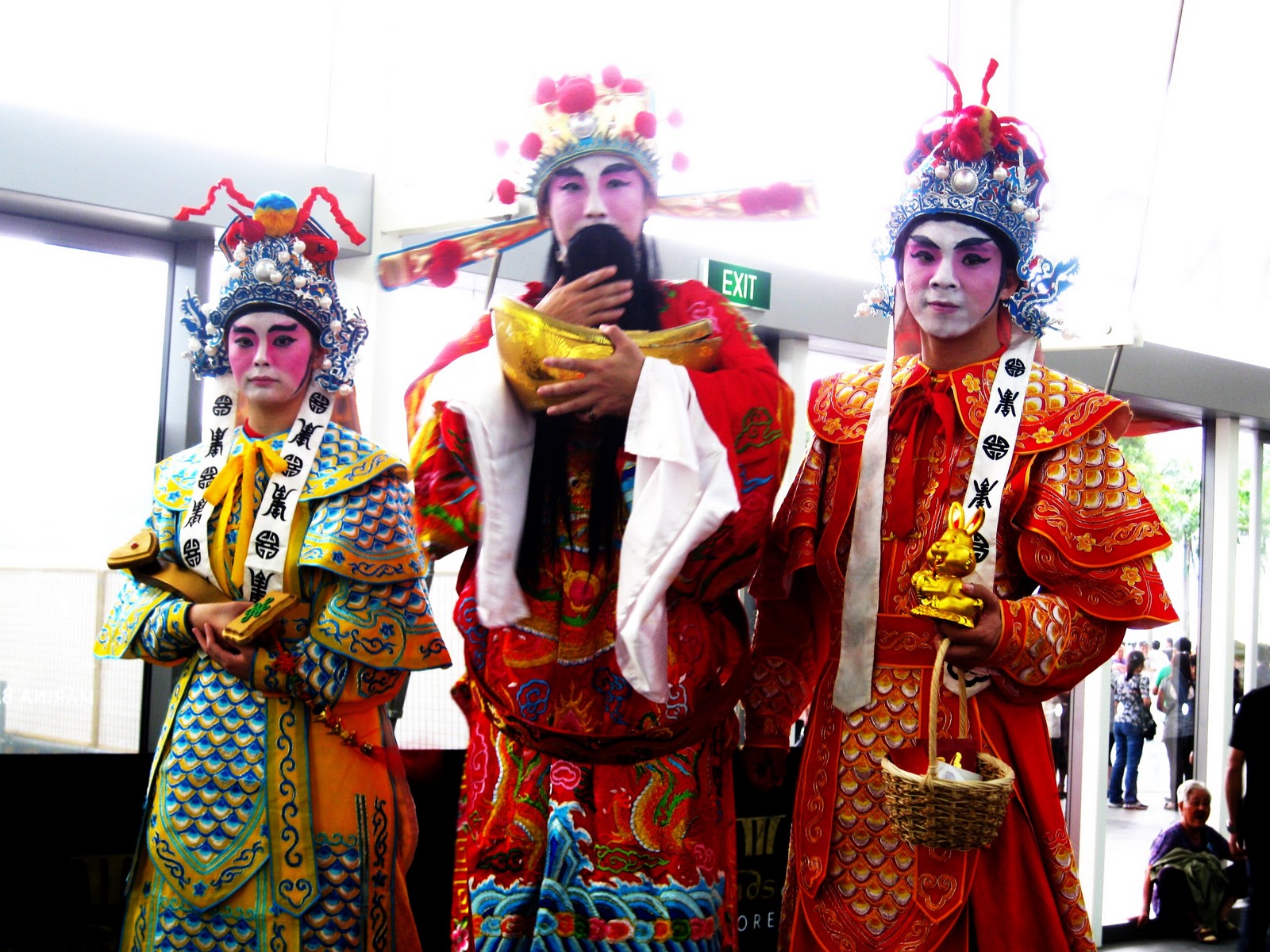 |
| As the God Of Wealth walked high on stilts to distribute "chocolate" candies during the Chinese New Year festive season, this old lady (Bottom Right) sat "alienated" and aimlessly near this exit door at the new MBS IR Resort. |
Looking at the “Hard facts on Singapore” [11 Feb 2011 – Articles] compiled by Dr. Foo Lung Sung, will our old voters really feel alienated when they actually cast the vote? Let’s ponder over these to assess what the writer had felt as the “The only truth about LKY's system of Govt. is it leads to us working harder and harder....sometimes for less.”
Will the same old iron-clad political style of the incumbent PAP Govt. still work in today’s fast-paced-Internet-savvy socio-political climate which traverses between the young and old voters?
While the global Chinese community is still in jubilant mood celebrating the auspicious start of Spring Festival 2011 (Lunar New Year), the Egyptians were also in jubilant mood all over Tahrir Square for a different cause [In Tahrir Square, we lost our fears and found ourselves; 13 Feb 2011 – International Media], as the “Crisis in Egypt” [11 Feb 2011 – Articles] ended the “The Day Mubarak Was Driven Out” [12 Feb 2011 – International Media].
“The reality is that Egypt's revolution leaves an unanswered question. If, as the evidence strongly suggests, social networks like Facebook and Twitter were crucial in organising the revolutions in Tunisia and Egypt, what does that mean about the nature of these revolutions and their ability to negotiate with the still strong remnants of the autocratic states left behind?” [Can Egypt's digital revolution unite the country? 13 Feb 2011 – International Media].
Conversely, by looking at “Hard Truths” may not solve the problems of the nature we witnessed in Egypt. Being “Out of Touch, Out of Time” [11 Feb 2011 – International Media] has embedded risks. As we watch the “Middle East braces for more protest after Mubarak resigns” [13 Feb 2011 - International Media, “Pro-democracy rally in Tehran”; 15 Feb 2011 – International Media], how will the social networks embrace our own electoral battles (or vice versa) as the GE draws closer?
After all as this article in Harvard Political Review [Dear Thomas Friedman: Serious In Singapore, But So What?; 14 Feb 2011 – Articles] puts it, Singapore is “the polar opposite to America”. “The whole project of American democracy is to try and limit the state’s power as much as possible”. For Singapore, “the state is leviathan” and “intimately involved in directing every sphere of society”. “Singapore’s citizens willingly concede their political power, trusting the state to deliver economic success on their behalf.”
However :-
“To have a functioning democracy, you need a functioning civic community. And community is all about the small things. It’s about the incremental increases in trust when you help someone out; the sharing of new ideas with new people; the building of a collective identity. Community helps a democratic society work out its shared values, and through this process, to ratify rules (and rulers) as legitimate.” – Harvard Political Review [Facebook Democracy; 14 Feb 2011 – Articles].
Nearer home, we had watched the Malaysian MM (Dr Mahathir Mohamad) slammed back at “lightning” speed at our MM Lee on Hard Truths [Hard Truths about Lee Kuan Yew (1); 12 Feb 2011 – Blog] via his blog posting. In this respect, Dr M is certainly more effective than our MM Lee who had to rely on a group of ST reporters to help him strike his blows in “hard print”, if this “battle of words” indeed could be taken as “The Battle between Two Despots” as described in the Internet.
Meanwhile, Singapore’s opposition had claimed its small “victory through the Internet” when the SDP managed to raise S$20,000 in donations to help its leader CSJ avoid jail [SDP's donation drive for Dr Chee is a mini victory; 19 Feb 2011 – Blogs]. The SDP said, “This is a historical development in that it is the first time that Singaporeans have rallied together to show such encouraging support for an opposition cause…..It is important that we continue to leverage on cyberspace to increase political space in Singapore. This exercise has given civil society and the opposition a gauge on the power of the new media.” Reform Party’s leader, Kenneth Jeyaretnam; also explained in his personal blog “why I paid good money to help keep my political rival out of jail”. [Keep my political rival out of jail; 10 Feb 2011 – Blogs].
“Facebook and Twitter are thus nothing more (and nothing less) than new tools for this older, democratic function: the distribution of information across networks; the communicative action between citizens; the creating of shared meaning. This is the hope that the Internet can bring to a repressed society like Egypt: not the killing of kings in Tahrir, but the building of a civic community once the square’s been emptied out.” [Facebook Democracy; 14 Feb 2011 – Articles].
Nevertheless, it takes a more matured Electorate in order to digest the vast information the social networks can harnessed.
Is FB democracy revolutionary? Will the use of the Internet and social media equivocally help to bridge an old divide between the “older” and “younger” voters, if age of voter indeed has a link to individual political maturity and knowledge? Or will this new media alienate the older voters even more to bias in the favour of the old mainstream media managed by the incumbent PAP Govt? As we quoted the Harvard Political Review above, “To have a functioning democracy, you need a functioning civic community. And community is all about the small things”. In doing such small things, no political giants or even despots could victimize the ordinary citizens. Finally, will this then bring about greater fairness to our “one-man-one-vote” system, even if it had not been tapered by OB markers?
More interesting links to articles are available at SGEP.
More interesting links to articles are available at SGEP.
Tuesday, 15 February 2011
Dear Thomas Friedman: Serious In Singapore, But So What?
Abstracted From
Harvard Political Review
By Alastair Su — February 13, 2011 at 2:18 pm
Last month, Thomas Friedman wrote a glowing account of governance in Singapore. This, I believe, isn’t the first time Friedman has written positively of the nanny state; given the sorry state of U.S. government nowadays, the prospect of Singaporean-style authoritarianism does appear to be a reasonable alternative — except it’s not.....
"America never would or should copy Singapore’s less-than-free politics. But Singapore has something to teach us about ‘attitude’ – about taking governing seriously and thinking strategically." .....
"For America, the state is weak but the society is strong. Using its elaborate system of checks and balances, the whole project of American democracy is to try and limit the state’s power as much as possible."
"In Singapore, it’s the polar opposite. The state is leviathan, intimately involved in directing every sphere of society. Singapore’s citizens willingly concede their political power, trusting the state to deliver economic success on their behalf." .....
"The second concerns the use of monetary incentives in the public service. If you want to understand pragmatism in Singapore, look at the payroll of our public servants. The top 30 most handsomely paid politicians in the world all come from Singapore; and even though Obama governs a country with 60 times as many people than Singapore, he is paid about 10% of Prime Minister Lee Hsien Loong (2008 figures) salary.".....
"Again, I won’t go into whether I think this is reasonable (consider, for example, the size of our politicians’ paychecks with the fact that Singapore’s gini-coefficient ranks one of the highest in the world). My basic point is that this comprises a vital part of Singapore’s political infrastructure, and it thus has no applications for America.".....
"Because America can’t learn from Singapore, it simply shouldn’t.".....
 |
| "a vital part of Singapore’s political infrastructure, and it thus has no applications for America."..... |
"Because America can’t learn from Singapore, it simply shouldn’t.".....
Thursday, 10 February 2011
The Property Bubble & Investment Trap Part XV - A New Spring with More Interest Rate Hikes?
The People's Bank of China (PBOC) 's rate hike on the last day of the long Lunar New Year holiday in China, just before the reverse flow of Chun Yun started, did not come as a surprise to many. The PBOC would raise the one-year deposit and lending rates by 25 basis points each, taking them to 3.0 percent and 6.06 percent respectively.
The bank raised rates for the first time in nearly three years last October as part of efforts to rein in inflation and property prices. The move was followed by another rise in late December. Inflation hit 4.6 percent year-on-year in December, down from 5.1 percent in November, which was the fastest rate in more than two years. And the full-year rate was 3.3 percent, exceeding Beijing's three percent target. Leaders have set the 2011 ceiling at four percent.
Market-watchers did not expect the latest move to have a huge impact on markets. "The rate hike hits market sentiment, but is unlikely to spark heavy selling on stocks as such tightening moves have been expected for some time", an analyst said. Afterall, the China stock market; unlike other Asian emerging markets, is still trying to lift off from level ground. And this could also possibly be where the newly minted "currency" from QEII will flow into Asia. The added risks are that QEII is not expected to solve the "UNEMPLOYMENT" woes of the US, as fresh waves of political uncertainly rock Egypt and the like economies where the income divide and proverty gap continues to aggravate.
Quite at odds with the China stock market is that its property market is said to be at its last phase of a Bubble before a possible burst next year (2012) according to Gillem Tulloch, Managing Director of Forensic Asia Ltd, in a recent interview with the Wall Street Journal's MarketWatch.
Mr. Tulloch said China's state-run banks will come under pressure to significantly rein in lending, leaving the economy short of more than 11 trillion yuan in credit. The Chinese banking system would fail to generate sufficient credit to sustain further increases in property prices. Credit needs to grow at double-digit rates to sustain property price gains, said Mr. Tulloch, adding that the lending boom is a sign of a market swept up in bubble dynamics.
You may recall that I also wrote on a few occasions in this Blog about a possible "2012 bust and 2015 boom" for the Singapore property market. In Part XI, I asked "will the next severe correction or burst of our bubble then come with the burst of The China Bubble around 2012 ~2013?". I also mention to watch the China market as the external driver. [See my posting on New Year Eve Dec 31, 2010 - External Drivers - Watching China in 2011].
Just like as soon as after China's previous interest rate hike in October 2010, Singapore's MTI & MAS is fast to announce that the S$ will be allowed to appreciate further in order to combat rising inflation. Our MAS practises a "monetary rate policy" through currency appreciation rather than by "interest rate policy" by adjusting interest rate as practised in China and other developed economies. In the current global climate, a higher monetary rate is good for international business but locally, the lower SIBOR rate defeated the point of having higher monetary rates. So in Mid October last year, the lowering of SINBOR rate favours the banks in the short-term but disadvantages those who overleveraged and over-committed on long term mortgages in the longer run, especially when interest rate starts to rise as in China. Political posturing is no longer about good governance alone. Welfare, benefits, a better way of life and free money have become major considerations to the voter on the street. Good governance seems a secondary consideration.
Judging from the recent launches of BTO flats, the market sentiments are certainly changing. MBT's rhetorics now cannot be wrong when he urged HDB owners aspiring to upgrade to private property to wait, as the General Election draws nearer, unlike his constant assertion that HDB flats are still affordable. "Housing prices are rather high now… if you wait for a while, you might find more affordable properties," Mr Mah was quoted as saying, citing the expectation of rising interest rates and an increase in the supply of private properties as factors in curbing property prices.
You may recall that I also wrote on a few occasions in this Blog about a possible "2012 bust and 2015 boom" for the Singapore property market. In Part XI, I asked "will the next severe correction or burst of our bubble then come with the burst of The China Bubble around 2012 ~2013?". I also mention to watch the China market as the external driver. [See my posting on New Year Eve Dec 31, 2010 - External Drivers - Watching China in 2011].
Just like as soon as after China's previous interest rate hike in October 2010, Singapore's MTI & MAS is fast to announce that the S$ will be allowed to appreciate further in order to combat rising inflation. Our MAS practises a "monetary rate policy" through currency appreciation rather than by "interest rate policy" by adjusting interest rate as practised in China and other developed economies. In the current global climate, a higher monetary rate is good for international business but locally, the lower SIBOR rate defeated the point of having higher monetary rates. So in Mid October last year, the lowering of SINBOR rate favours the banks in the short-term but disadvantages those who overleveraged and over-committed on long term mortgages in the longer run, especially when interest rate starts to rise as in China. Political posturing is no longer about good governance alone. Welfare, benefits, a better way of life and free money have become major considerations to the voter on the street. Good governance seems a secondary consideration.
Judging from the recent launches of BTO flats, the market sentiments are certainly changing. MBT's rhetorics now cannot be wrong when he urged HDB owners aspiring to upgrade to private property to wait, as the General Election draws nearer, unlike his constant assertion that HDB flats are still affordable. "Housing prices are rather high now… if you wait for a while, you might find more affordable properties," Mr Mah was quoted as saying, citing the expectation of rising interest rates and an increase in the supply of private properties as factors in curbing property prices.
In view of the lack lustre property market, property agents are taking longer CNY vacations and developers are sending out SMS from the 5th Day of CNY to invite potential buyers for show-flats viewing. Meanwhile the URA is reviewing rules to ensure that showflats look like the apartments that eventually get built to ensure that buyers get what they pay for.
And you may also want to visit this posting by a property agent, "Private property market in Singapore to crash in late 2011?", though a general reading on the "superheated state of property price" in Singapore, the impact of the recent control measures as the GE gets nearer.
Reacting to public discontent with the rising cost of public housing, PM Lee used his Chinese New Year speech to address the number one issue of dissatisfaction amongst Singaporeans. In what promises to be an election year for the PAP, Lee reassured to "keep housing affordable to Singaporeans, especially public housing."
In a recent survey it was shown that “the bottom 20 per cent of households suffered disproportionately from higher housing prices.” It was these households that the government measures to cool the market were aimed at.
However, one group, the middle class, is being increasingly squeezed by rising property prices, earning too much to qualify for HDB housing, but priced out of the private property market. Those who already own a property but still servicing their mortgage would most probably likely be still struggling to pay off their old mortgage loan as a result of lower CPF rates and income ceiling cap on CPF during the previous economic downturn.
Recent euphoria in the EC market seems to suggest younger buyers are either ignorant or had forgotten the "suffering" of their older peers in times of back economic performance. Both PM Lee and the MND ministers' warning have probably come too late for these ignorant buyers while the Govt was cautious to want to protect the property value in an Election year by arguing that “in a prospering economy home owners should see their properties appreciating in value over the long term.”
One should understand the mechanics of our property market versus the mechanics of politics to invest wisely in our property market. Just 6 months ago, MM Lee had said "There is probably no bubble in Singapore's property market,...". The occasion was a dinner hosted by the Association of Banks in Singapore.
"The sharp price rises that have been seen are 'part of the total liquidity in the whole world system', said Mr Lee, noting that interest rates are low, and foreigners still see properties as affordable.
'Even if we cap our excess, people in Hong Kong, Indonesia, will say, compared to what I have to pay, Singapore is cheap, let's buy it,' he added.
Perhaps, local middle earners should ask "why are our own wages stagnated if compared to these foreigners" or "why are these foreigners able to make so much more money easily then us"! If not, where have our incomes been diluted?
Two months later in end August 2010, MBT was "caught off guard" as the MND Minister announced a new round of control measures. Yet he was not very convinced then, and more stricter "incremental" measures had to be taken again only in mid January 2011.
MM Lee said then, "These are the precautions we can take, but it does not stop the Indonesians or the Thais or the Malaysian Chinese or the Filipino Chinese from coming here and saying, 'Compared to what I have to pay in my country, this is cheap." The bankers must be pleased by his statement then, but look at what it had done in 2 months. He was responding to a question by a Standard Chartered banker who had asked about whether he was worried about property prices here.
The banker had also tacked on a second question: 'Can we expect elections anytime soon?'
To that, Mr Lee replied: 'I am not the Prime Minister, I don't decide. And anyway it's got nothing to do with a property boom.'
If an Election has nothing to do with a property boom accordingly to MM Lee, a "BUST" certainly does, as judging from PM Lee's concern during his recent new year speech.
Anybody can just excuse himself from getting "caught off-guard" but I certainly would empathise with those who are caught off-guard now due to these politicians' speeches and policies if they had invested without digesting but believeing such "hearsay" information.
And if you are still unclear or not convinced what "hearsay" might be all about, you may want to visit this web-site to see what this FT agent committed,
"I've been helping people find the homes they want for a few years now. It is about providing a service, not skimming a fat commission. That is how I work..."
And guess whom he had quoted on 29 June 2010 ! [Do pay this FT agent a visit at his website.]
It does not matter that one has a CEA No. and that MBT had "cut-and-paste" policies from HK to register and regulate real-estate agents here in Singapore.
Anyway, let's "spring" ahead by watching the external drivers diligently, while enjoying more of such hearsay political posturing in an Election year.
Reacting to public discontent with the rising cost of public housing, PM Lee used his Chinese New Year speech to address the number one issue of dissatisfaction amongst Singaporeans. In what promises to be an election year for the PAP, Lee reassured to "keep housing affordable to Singaporeans, especially public housing."
In a recent survey it was shown that “the bottom 20 per cent of households suffered disproportionately from higher housing prices.” It was these households that the government measures to cool the market were aimed at.
However, one group, the middle class, is being increasingly squeezed by rising property prices, earning too much to qualify for HDB housing, but priced out of the private property market. Those who already own a property but still servicing their mortgage would most probably likely be still struggling to pay off their old mortgage loan as a result of lower CPF rates and income ceiling cap on CPF during the previous economic downturn.
Recent euphoria in the EC market seems to suggest younger buyers are either ignorant or had forgotten the "suffering" of their older peers in times of back economic performance. Both PM Lee and the MND ministers' warning have probably come too late for these ignorant buyers while the Govt was cautious to want to protect the property value in an Election year by arguing that “in a prospering economy home owners should see their properties appreciating in value over the long term.”
One should understand the mechanics of our property market versus the mechanics of politics to invest wisely in our property market. Just 6 months ago, MM Lee had said "There is probably no bubble in Singapore's property market,...". The occasion was a dinner hosted by the Association of Banks in Singapore.
"The sharp price rises that have been seen are 'part of the total liquidity in the whole world system', said Mr Lee, noting that interest rates are low, and foreigners still see properties as affordable.
'Even if we cap our excess, people in Hong Kong, Indonesia, will say, compared to what I have to pay, Singapore is cheap, let's buy it,' he added.
Perhaps, local middle earners should ask "why are our own wages stagnated if compared to these foreigners" or "why are these foreigners able to make so much more money easily then us"! If not, where have our incomes been diluted?
Two months later in end August 2010, MBT was "caught off guard" as the MND Minister announced a new round of control measures. Yet he was not very convinced then, and more stricter "incremental" measures had to be taken again only in mid January 2011.
MM Lee said then, "These are the precautions we can take, but it does not stop the Indonesians or the Thais or the Malaysian Chinese or the Filipino Chinese from coming here and saying, 'Compared to what I have to pay in my country, this is cheap." The bankers must be pleased by his statement then, but look at what it had done in 2 months. He was responding to a question by a Standard Chartered banker who had asked about whether he was worried about property prices here.
The banker had also tacked on a second question: 'Can we expect elections anytime soon?'
To that, Mr Lee replied: 'I am not the Prime Minister, I don't decide. And anyway it's got nothing to do with a property boom.'
If an Election has nothing to do with a property boom accordingly to MM Lee, a "BUST" certainly does, as judging from PM Lee's concern during his recent new year speech.
 |
| Property prices are now just like this Rabbit tossed in mid-air. Can it hop higher or will it sustain a big fall ? |
And if you are still unclear or not convinced what "hearsay" might be all about, you may want to visit this web-site to see what this FT agent committed,
"I've been helping people find the homes they want for a few years now. It is about providing a service, not skimming a fat commission. That is how I work..."
And guess whom he had quoted on 29 June 2010 ! [Do pay this FT agent a visit at his website.]
It does not matter that one has a CEA No. and that MBT had "cut-and-paste" policies from HK to register and regulate real-estate agents here in Singapore.
Anyway, let's "spring" ahead by watching the external drivers diligently, while enjoying more of such hearsay political posturing in an Election year.
References :-
China property bubble to burst next year
http://sg.news.yahoo.com/pg/20110207/tbs-china-property-bubble-to-burst-next-b71e0e1.html
Private property market in Singapore to crash in late 2011?
http://www.sg-house.com/classifieds/property-news-and-knowledge/3552272-private-property-market-in-singapore-to-crash-in-late-2011-a.html
PM Lee: We will provide affordable housing
http://sg.yfittopostblog.com/2011/02/09/pm-lee-we-will-provide-affordable-housing/
Probably no property bubble here yet: MM
http://www.pmo.gov.sg/content/pmosite/mediacentre/inthenews/ministermentor/2010/June/probably_no_propertybubblehereyetmm.html
http://sg.yfittopostblog.com/2011/02/09/pm-lee-we-will-provide-affordable-housing/
Probably no property bubble here yet: MM
http://www.pmo.gov.sg/content/pmosite/mediacentre/inthenews/ministermentor/2010/June/probably_no_propertybubblehereyetmm.html
Tuesday, 8 February 2011
Election Watch Part V - In Search of the Young Voters
The following article is contributed to the Singapore General Election Portal (SGEP). The articles refered to herein can be found in the SGEP.
In Search of the Young Voters
This year, the celebration of Chinese New Year coincides with the start of Spring (Li Chun) on Feb 04. If the Lunar New Year starts after the 1st solar term – Li Chun, it would be referred to as a “blind” year, and it is a bad omen of unfavorable outcome or unsuccessful year. So, this Year of the Metal Rabbit should be quite auspicious although it is not a “double spring year”, such as 2009 the Year of the Earth Ox; which is supposed to be most auspicious.
As "springtime" broadly signifies the season of ideas of rebirth, renewal and regrowth, let’s go in search of the likely profiles of young voters and new citizens in the coming General Election.
In November last year, I wrote to the SGEP to highlight a posting in Yu Kym's Blog [Do you hate Singapore?; 20 Nov 2010 – Blogs] to illustrate how an increasingly apathetic younger electorate may be completely out of context with issues for them to vote wisely in the coming GE. [A Response To Yu-Kym's "DO YOU HATE SINGAPORE?"; 3 Dec 2010 – Articles]. In this postingl, I like to highlight another posting "Hardship" [07 Feb 2011 – Blogs] by another blogger in the early dawn hours the day after Li Chun (Feb 5). While many Singaporeans would probably be asleep at those hours since it was already the 3rd Day of Chinese New Year, what the writer had posted must have been most thought-provoking for him to put in writing then.
This blogger (in his mid-20s and an eligible voter) having just read MM Lee’s newest book on Hard Truths said :-
"wonder.. how many of us can truly say we've been through hardship. the type that our parents have.. the type that our forefathers have been through.
we come from a generation who have not seen our friends die right in front of our eyes .. nor have we seen death at our door steps. we have not been in situations where its either do or die. where we simply just anxiously await another day to live.
Lee Kuan Yew's generation saw war when they were teenagers. Lee Hsien Loong saw racial riots when he was in secondary school. What has our generation seen?”
The writer started his argument on a solid footing of understanding “hardship” by paying tribute to an older generation of Singaporeans. This was great. The intention was obviously also to support his admiration of what MM Lee had done for Singapore as an social “architect” who “structured Singapore with words”. The rhetoric of his arguments soon drifted when he started to cast aspersions on his young Singaporean peers who disagree with our political system:-
"I'd rather Lee Kuan Yew's critics be the western media than a fellow Singaporean. Who knows how much this man has sacrificed and cried for a land that Singaporeans would leave at the first sign of danger. These men and women who so proudly slam their own country ( as though they were trying to free us from oppression) in the name of justice would leave Singapore simply because they can and they couldn't care one bit about the country that has provided the stability so they could study without having to worry if the next day they might be robbed on the way to school."
"I wonder.. how many Singaporeans would die for this land.
This land of miracles."
"The reason why there is Singapore is because we had men who gave a damn about our country.”
"Our country is full of talent. However, the kinds of talent we have are shallow. Because they are easily bought by money. Dangle some loose change in front of them and they would prostitute themselves, sell you their families and sacrifice their friends, throw away any integrity they have. That's where our talents are going. To where the money leads them."
"Unless we can make Singaporeans see that they are not just any people who can be bought by money... we would eventually sell our integrity. The only thing that makes us stand out from Malaysia, Indonesia and many of our neighbouring countries. This is perhaps why we are valued far more than other countries. Our nobility lies in our government's integrity."
"Problem is.. our people are too shallow to even realize how much more our government has sacrificed when they could have just easily taken the easy route out."
 |
| Will Singaporeans sell our integrity? |
"Problem is.. our people are too shallow to even realize how much more our government has sacrificed when they could have just easily taken the easy route out."
"Why do we envy a country like America which has so much freedom of speech?..."
"Singapore is still in a safety zone where this situation has not happened. We still have a majority of people, the older generation, who know and understand that their government has sacrificed much for us. But our younger generation.. who doesn't even know why they are 'forced' to enter NS think that .. the government is forcing them to do something they are not supposed to."
While the writer who is about to graduate (or has just graduated) from NUS is not ignorant but recognised the existence of an older generation who had gone through “hardship”, is Singapore really in a “safety zone” as he claimed, especially when the average younger Singaporeans he described is so hopeless in his eyes?
Read this opposing view – ["Hope for Singapore”; 7 Feb 2011 – Blogs].
"And once more I don’t get how criticizing the PAP and its policies is a direct attack on Singapore. If I criticize the ministers and their policies, if I criticize the unrelenting pursuit of GDP growth at the expense of the happiness of the citizens, it is not because I hate Singapore or want to attack it. It is because I care about Singapore and the direction it is heading. Does this writer not know the difference between constructive criticisms and slamming?"
"What I want is an egalitarian Singapore where everyone has equal opportunities opened to them and that as long as one is willing to work hard, social mobility is never denied to them- not the current elitist society socially engineered by the PAP that ensures they, their progeny and their cronies will forever lord it over the rest of us."
"Remember our forefathers did not escape from the tyranny to slave and slog and to build Singapore to what it is so that we can live under another form of tyranny."
If indeed it is a “heart issue” as the first blogger had suggested, “that has to be resolved before we can talk about solving the structural issue”, then what has gone wrong with MM Lee as our social “architect” who "structured Singapore with words" and our education system?
Will the sudden “drumming-in” of Hard Truths in our young “shallow” voters and / or new citizens transform them into intelligent and responsible voters overnight? In upholding a “beholden” view of MM Lee’s Hard Truths and our political system, does it accord one with a right to abhor others about other alternative political thinking?
We need not see “our friends die right in front of our eyes” or “death at our door steps” in order to appreciate the situation [Change in Egypt will take time: George Yeo – 7 Feb 2011 – Blogs] and take in "Lessons from Cairo" [7 Feb 2011 – Blogs].
Let's hope the younger generation of voters and new citizens will not turn this Election year into a “blind” year.
More interesting links to articles are available at SGEP.
More interesting links to articles are available at SGEP.
Tuesday, 1 February 2011


Saturday, 29 January 2011
Election Watch Part IV - Hard Truths on Climate of Fear
The following article is contributed to the Singapore General Election Portal (SGEP). The articles refered to could be found in the SGEP.
Hard Truths on Climate of Fear
The following were the questions posed by a team of 7 Straits Times journalists to MM Lee and his answers were eventually included as part of his latest book, Lee Kuan Yew: Hard Truths To Keep Singapore Going. [MM Lee, does your food go through a food taster? – 26 Jan 2011 – Local Media]
Q: Is the ‘climate of fear’ Singaporeans feel here partly your doing?
A: ‘Come off it! Are you fearful? If you’re fearful why do you ask me this question? Is anything going to happen to you? Utter rubbish!’
Q: We may not personally be fearful but we did encounter quite a few young people who were.
A: ‘I cannot explain that and I’m not interested whether they’re fearful or not fearful. I think it’s better that they’re fearful and they take me seriously, than if they think I’m somebody they can brush off. That’s all. And if you’re the prime minister and you’re brushed off, you’re in trouble.’
The last sentence, “And if you’re the prime minister and you’re brushed off, you’re in trouble”, must be the most interesting.
The Nature of Fears
Based on theoretical research, the categories of fears may be linked to Maslow's hierarchy of needs – Physiological, Safety, Love and belonging, Esteem and Self-actualization.
Fears associated with the basic needs of Physiological, Safety, Love and belonging are often linked to "Loss". We fear that we will not have “food” if we lose our jobs. We fear we will not have a “roof” over us if housing is not affordable. We fear to lose our loved ones if they are very sick and medical costs are high.
At the higher level, fears associated with the needs of Esteem and Self-actualization is often linked to “Fear of Failure” and “Fear of Success”. We fear about failing our examinations. We fear that once we are successful in our careers, we may have lesser time and freedom.
Obviously, MM Lee is “not interested” whether Singaporeans are “fearful or not fearful”. Who set the OB markers? Who is guaranteed a job and high salary and who is not? Who is guaranteed a “roof” and who is not? Who can “manage” to have a heart operation at $8 and who cannot? And if you had “Already demolished the rivals” [ 25 Jan 2011 – Blogs], what is there to fear about?
And obviously the easiest way an Electorate could be threatened is such as to link “lift upgrading” to the vote when there was no “cooling-off” period, i.e. to capitalise on the basic “physiological” weaknesses and fears of the Electorate. The converse is to offer “Election carrots”.
As the fears climbed to “Esteem and Self-actualization” level, the threat is somewhat more leveled and this is synonymous with a more sophisticated Electorate. We are no more the first generation of “kampong folks” shifting into the satellite town of Toa Payoh.
Fear of Failure
The PAP fears failures, particularly in the face of various slackening performance records by various Ministers in the previous year. Comparatively, the likely Opposition candidates are more noticeable as they have nothing to fear about failing. They are even more noticeable than whom the next likely 4G Prime Minister or President will be.
Fear of Success
The PAP fears about its own success. It fears to have more than 2 opposition MPs. It fears to lose a GRC which is cited as its success to prevent under-representation of the minority races. In contrast, the Opposition has no fears about success. So what if LTK and CST are re-elected again for Hougang and Potong Pasir, the basic fears about losing their lift-upgrading and MRT station is not there anymore.
The “Esteem and Self-actualization” needs of MM Lee must have been to demolish those “duds” he thinks "deserve to be demolished”. [MM Lee on why he demolished rivals...; 25 Jan 2011 – Blogs]. But this is a fear linked to his success. Does it deliver "common good" to the ordinary people of Singapore?
Do you fear when issues are brushed off?
The answer must be certainly YES as the Electorate gets more sophisticated with its “Esteem and Self-actualization” needs.
The high cost of living will certainly be a key Election topic. Inflation here hit 4.6 per cent last month - the highest since December 2008 - due to rising transport, housing and food prices. GST was raised after the last Election and rumoured would be raised again after the coming one. These are basic fears adversely affecting the pockets of the Electorate. [Inflation at highest level since Dec '08; 26 Jan 2011 – Local Media].
At a community event in Marine Parade, SM Goh spoke on rising prices, "I would expect the Finance Minister to come up with some ways to help lower the cost of living for Singaporeans. How he does it - I do not know at this stage, how much he wants to do, I do not know at this stage, but logically speaking, it'll be surprising if he doesn't do anything." [Prices of food items should be stabilized; 23 Jan 2011 – Local Media].
In another event, PM Lee assured Singaporeans there's no cause for alarm… "In 2008, when food prices went up sharply also, particularly rice prices at that time, there was a shortage of supply and wholesale prices went up by 50 percent, even more. And in Singapore we had to make sure that we had enough supplies and we were able to maintain, keep the prices stable, and see ourselves through that period. After a few months, the prices came down again and inflation stabilised. I expect that to happen again this time."
If you walk into a NTUC Fairprice supermarket and find that a box of 28~30 (XL) Lukan oranges are selling substantially at a higher price as compared to another neighbourhood supermarket, will you logically be surprised and alarmed? We are not talking about “Bakkwa” which cost $48~$50 / kg, at least you have to hold 2 oranges in your hands when you go CNY visiting?
If you walk into a NTUC Fairprice supermarket and find that a box of 28~30 (XL) Lukan oranges are selling substantially at a higher price as compared to another neighbourhood supermarket, will you logically be surprised and alarmed? We are not talking about “Bakkwa” which cost $48~$50 / kg, at least you have to hold 2 oranges in your hands when you go CNY visiting?
 |
| Yong Chun Lukan 28/30 (XL) cost $12.50/box at SHOP n SAVE Supermarket (incl GST) |
What the ordinary Singaporeans need is not just reassurance through good PR, if not propaganda. “PM Lee: Govt knows who the most needy are”; 23 Jan 2011 – Local Media]. And are you just trying to save the trouble by just helping the needy, through the Finance Minister’s blunt “budget axe”?
 |
| Same Lukan cost $16.88 / box at NTUC Fairprice (35% more expensive) |
Look at what the Malaysian Ministers are doing? [11 items on M'sian price control list for CNY; 24 Jan 2011 – Malaysia Media]. Eleven items have been placed on the price control list for the coming CNY celebrations - Among the items are live chicken, standard chicken (slaughtered with head, feet, liver, and gizzard), super chicken (slaughtered without head, feet, liver and gizzard). Also included are graded eggs, imported round cabbages from Indonesia and China (not including from Beijing) bawal putih (white pomfret), udang putih besar (large prawns), pork (belly) and pork (lean and fat).
No wonder Malaysia has an “innovative” ministerial portfolio of “Domestic Trade, Consumerism and Co-operatives Minister”. And this Malay Minister is certainly doing his job well. He said these items were popular with the Chinese community. Conversely, MM Lee is urging Singapore Muslims to “be less strict on Islamic observances” to aid integration. [LKY's concerns about Islam unjustified; 27 Jan 2011 – Malaysia Media].
 |
| Items Under Price Control in Malaysia |
"When you are a very old politician, younger people will always see you as out of touch, irrelevant, even a hindrance.” [Minister Mentor's remarks on integration draw flak; 27 Jan 2011 – Blogs]. Aspiring to a middle-class lifestyle is not the problem [27 Jan 2011 – Letters] for Singapore. Are our Ministers thinking too much but doing too little basically for the common good of our people? ]. For the Electorate, the "Mother” of all fears must be when issues are simply brushed off. “And if you’re the prime minister and you’re brushed off, you’re in trouble”.
Visit SGEP for more links to interesting articles.
Thursday, 20 January 2011
Speculation, really? - A Belated ex-PM's Dream
I refer to the attached letter (Reference #01) by Mr. James Chi Han-Hsuan to TODAY (Jan 17, 2011).
I agree substantially with his argument except the portion striked out by me, vide "In fact, the high prices of new condos are, to an extent, the result of the growing size of bids under the Government Land Sales programme, rising construction costs and the high development and other charges tied to en bloc projects."
As I had pointed out before in this bloc, the inherent problem lies with the Govt Land Sales bidding system and the final pricing of DBSS and EC.
As for construction costs, it is not really rising. Many are often misled into thinking they are. In fact, some trades are still clinging onto historical low prices. When compared to the high construction costs in 2006 / 2007 due to high "steel prices and then sand ban", current construction costs are really a blessing. Not forgeting that the weakened Euro$ also mean cheaper finishing materials like high quality marbles and tiles.
As for construction costs, it is not really rising. Many are often misled into thinking they are. In fact, some trades are still clinging onto historical low prices. When compared to the high construction costs in 2006 / 2007 due to high "steel prices and then sand ban", current construction costs are really a blessing. Not forgeting that the weakened Euro$ also mean cheaper finishing materials like high quality marbles and tiles.
The problem lies with the integration of "Design and Build" contractors up the value chain into the "development process". It is supposed to provide a cheaper package altogether and more competitive prices for the end purchasers but instead "Design and Build" contractors were bidding excessively for land bids and added to that even if their construction costs were reasonable, would still not press down final prices. Instead the buyers ended up paying higher prices and generally in Singapore, the individual Financial Quotient is not there. Instead buyers take for granted the GOVT has a good system in place to push the price even higher and would save them at the end of the day. This is the fault arising from the "asset enhancement" scheme for public housing. This wrong mindset, I believe is the greatest risk to our Bubble. Imagine "Dell Computers" after cutting the middleman's costs and still selling you at "SONY Computer" prices directly.
I had written about The New Millennium Dream In Retrospective. The present EC Euphoria is a Belated PM's Dream of SM Goh. I tend to agree with what this TODAY online commenter (ERG) said :-
"If there's one man to be blamed for decades of rampant, escalating property prices, it must surely be goh chok tong.
He spoke incessantly, during his seat-warming years, about 'asset enhancement' and how even HDB dwellers were becoming 'half-millionaires'.
Mah Boh Tan has had the unenviable task of trying to put the genie back into the bottle."
He spoke incessantly, during his seat-warming years, about 'asset enhancement' and how even HDB dwellers were becoming 'half-millionaires'.
Mah Boh Tan has had the unenviable task of trying to put the genie back into the bottle."
And imagine and look at how this "multi-million" boss of our GLC developer (Reference#02) is crying foul himself when they also play a part in the bidding process and join the speculation fray:-
"We are amazed at the prices that come out (in government land tenders)," he said. "Not that we are jealous but when we look at the numbers, we know that we can't do it. So in a way, we agree that there is some speculative chasing for land."
You should ask him how the D' Leedon at Farrer Road is priced?


Spiralling Towers, Spiralling Prices.
As a "pre-emptive" measure, even if they came slowly, the new measures are necessary. Unlike China, where the property market is in a Bubble but the stock market not relatively heated up last year. Most China property speculators are into a few properties, and they are hoarding to hedge against inflation. If one Chinese owns 3 properties, I can bet you, he has at least paid up 2 of them. So only the last property is at risk. In Singapore, many are just owning one and the richer one is trying to have 2 but both not paid up. Few own as many properties as the Chinese mainland investors. This exposes another risk in our property Bubble.
Our stock market is very much heated up right now and as S$ appreciates further, more capital inflows are expected into our "safe haven" and our Govt will take it positively as a plus for Singapore as a financial centre. Nothing will be done to curb such captial inflows. The Govt may even allow to appreciate the S$ at the expense of our costlier exports. As I explained before, after the stock market is played up, the gains will be re-invested in properties and then inflate the property market further. If the condo resale market heats up further, the EC market will climb to new heights although new buyers have to observe a MOP of at least 5 years. It will push prices higher in the long-term which our Govt proudly calls "asset-enhancement".
So cutting short-term gains by pushing up the SSD rates to 16%, 12%, 8% and then 4% is a way to stop further price escalation. But I see prices as still high until new benchmarks are set in with a consolidation of prices in the current property market. Prices of "leftover" units should fall. No control measures can be more effective than banning speculation in sub-sales before actual physical completion of residential properties or obtaining TOP. This has a better impact to prevent spiralling prices in the long-term.
Reference #01 :-
TODAY Jan 17, 2011
Letter from James Chi Han-Hsuan
I refer to the property cooling measures, which are supposedly aimed at curbing market speculation. Between the last cooling measure on Aug 30 and the latest one, there is no clear data to show that the upward movement in prices has been due to speculative activity of any sort.
The latest price hikes can be attributed mainly to the new property launches by developers, and since the prices are not within the control of buyers, how could the uptrend in transacted prices be deemed a sign of speculation?
There is also no way it can be proved conclusively that buyers of properties after Aug 30 were speculators, since few who bought a property then would likely have sold it off before the latest measure. In fact, the high prices of new condos are, to an extent, the result of the growing size of bids under the Government Land Sales programme, rising construction costs and the high development and other charges tied to en bloc projects.
Resale property prices are in part influenced by prices of new launches, as valuers would factor in transacted prices of condos in the vicinity when valuing a property. In short, rising property prices are not just a matter of "willing buyer, willing seller".
Reference #2:-
Yahoo News
Propertyguru - Monday, January 17
Subscribe to:
Posts (Atom)


 Posts
Posts


